
In civil engineering and infrastructure development, ground conditions are rarely ideal. High water tables, loose sands, and unstable soils present significant challenges for excavating deep foundations, digging subway tunnels, or waterproofing basements.
To overcome these geotechnical challenges, engineers rely on construction grade bentonite.
This natural clay mineral is an essential component in civil engineering, providing mechanical support, lubrication, and waterproofing capabilities.
1. Slurry Trenching, Piling, & Diaphragm Walls
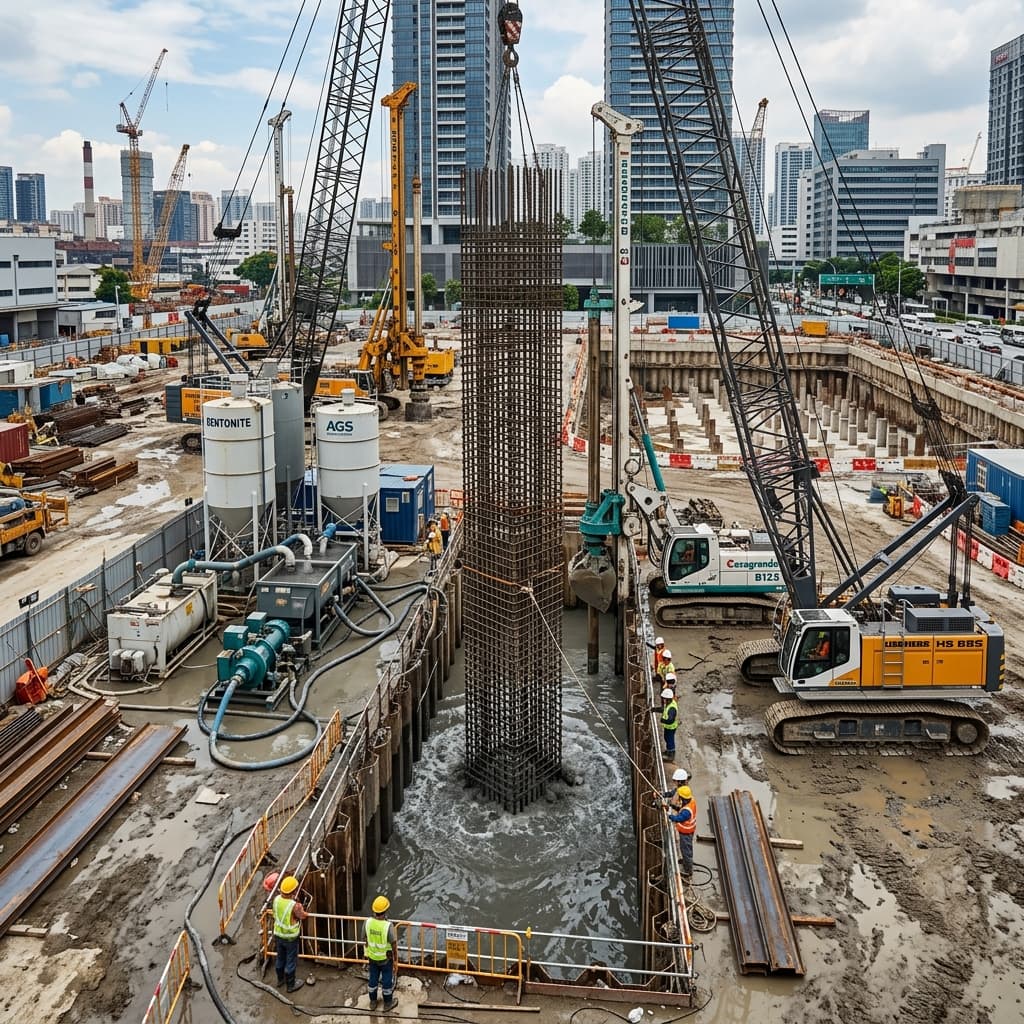
When building skyscrapers, bridge piers, or subway stations, deep trenches must be excavated before pouring concrete. Without support, the surrounding soil would quickly collapse into the trench.
- The Slurry Method: The trench is filled with a bentonite-water slurry (usually 4% to 6% clay concentration) during excavation.
- Hydrostatic Pressure: The weight of the heavy slurry pushes outward against the excavation walls, counteracting the pressure of the surrounding soil and groundwater.
- Filter Cake Sealing: The flat clay plates plaster the trench walls, forming an impermeable membrane (filter cake). This prevents water from seeping into the trench and keeps the slurry water from escaping into the surrounding soil.
- Concrete Displacement: Once the excavation reaches its target depth, steel reinforcing cages are lowered into the slurry. Concrete is then pumped in from the bottom up. Because concrete is denser than the bentonite slurry, it displaces the slurry, pushing it out of the trench to be reclaimed and recycled.
2. Tunneling and Microtunneling (Trenchless Technology)
For underground utility installation and subway excavation, tunnel boring machines (TBMs) rely on bentonite for lubrication and soil stabilization:
- Face Stabilization: In soft ground tunneling, a bentonite slurry is injected under pressure at the cutterhead to support the excavation face and prevent cave-ins.
- Friction Reduction: During pipe jacking (pushing concrete pipes underground), a bentonite slurry is injected into the annular space between the pipe and the soil. This acts as a lubricant, reducing friction and allowing pipes to be pushed over longer distances.
- Cuttings Transport: Similar to oil drilling, the slurry carries excavated soil and gravel back to the surface separation plant.
3. Waterproofing & Environmental Containment
Bentonite's high swelling index makes it an exceptional waterproofing barrier:
- Geosynthetic Clay Liners (GCLs): These liners consist of a layer of sodium bentonite sandwiched between two geotextile fabrics. GCLs are used to line canals, water reservoirs, and landfill cells, forming a self-sealing barrier that blocks water flow.
- Self-Healing Mechanics: If a GCL panel is punctured by a stone or root, the dry bentonite exposed to water swells rapidly, filling the hole and sealing the leak.
- Underground Waterproofing: Bentonite panels are installed around basement walls and foundations. When groundwater contacts the panels, the clay swells to form a seamless gel membrane that prevents water intrusion.
Key Technical Parameters for Construction Bentonite
To ensure excavation stability, the bentonite slurry must be regularly tested at the construction site:
| Test Parameter | Recommended Range | Test Method / Equipment | Significance |
|---|---|---|---|
| Apparent Viscosity | 32 to 50 seconds | Marsh Funnel | Measures flow and carrying capacity. |
| Density (Specific Gravity) | 1.03 to 1.10 g/cm³ | Mud Balance | Determines hydrostatic pressure. |
| pH Value | 8.5 to 10.0 | pH Strips/Meter | Controls clay dispersion and stability. |
| Sand Content | Less than 3.0% | Sand Content Kit | High sand content degrades pumps and reduces slurry quality. |
| Cake Thickness | Less than 2.0 mm | Filter Press | Thin cakes ensure clean concrete bonding. |
Conclusion: Engineering with Confidence
Using high-grade construction bentonite is critical to the safety and durability of modern infrastructure. Substandard clay can lead to slurry degradation, wall cave-ins, and water leaks in finished structures.
Marjaan Minerals supplies premium construction grade sodium bentonite tailored for piling, diaphragm walls, tunneling, and waterproofing applications, ensuring compliance with strict geotechnical engineering standards.