In the energy exploration sector, oil and gas wells are drilled miles deep into the Earth's crust. Under these extreme conditions of pressure and temperature, drilling operators rely on a specialized fluid system known as drilling mud.
Without drilling mud, drilling would be impossible—wells would collapse, drill strings would bind, and pressure spikes could trigger catastrophic blowouts.
At the heart of water-based drilling mud is drilling grade bentonite, an industrial mineral that controls the fluid's flow behavior (rheology) and seals the borehole wall.
This technical guide covers how bentonite functions in drilling systems, its chemical mechanics, and the international standards that govern its quality.
What Is Drilling Mud, and Why Is Bentonite Needed?
Drilling mud is circulated down the inside of the drill string, through the nozzle of the drill bit at the bottom, and back up the space between the drill pipe and the borehole wall (the annulus).
Sodium bentonite is added to water-based muds to serve three primary functions:
1. Viscosity and Cuttings Transport
To carry heavy rock fragments (cuttings) generated by the drill bit to the surface, the drilling fluid must be thick enough to prevent them from sinking. Sodium bentonite particles hydrate in water, creating a network of plates that increases the fluid's viscosity. This keeps the cuttings suspended as they are carried out of the hole.
2. Thixotropic Behavior (Gel Strength)
Thixotropy is the property of a fluid that allows it to behave as a liquid when stirred or agitated, but transition into a solid gel when left at rest.
- While drilling: The movement of the drill string keeps the mud in a liquid state, allowing it to flow easily.
- When drilling stops: (e.g., during pipe additions or maintenance), the flow ceases. The mud quickly forms a gel structure, locking the rock cuttings in place and preventing them from falling to the bottom of the well, where they would pack around and trap the drill bit.
3. Filtration Control (Filter Cake Formation)
As drilling mud travels down the borehole, it passes through various porous rock formations (like sandstones). If the water in the mud escapes into these formations, the clay concentration rises, causing the mud to become thick and unusable.
- Bentonite plates align against the porous rock faces, layering over each other like shingles on a roof.
- This creates a thin, tough, and impermeable layer called a filter cake.
- The filter cake prevents fluid loss into the surrounding rock, seals the borehole, and stabilizes the well wall against structural collapse.
Rheology: How Bentonite Behaves under Stress
The flow characteristics of bentonite suspensions are described by plastic viscosity (PV) and yield point (YP):
- Plastic Viscosity (PV): Represents the mechanical resistance to flow caused by the friction between solid particles and fluid layers. A lower PV is preferred for fast drilling, but it must be balanced to ensure proper cuttings transport.
- Yield Point (YP): Represents the electrochemical forces between clay particles under flow conditions. It measures the fluid's ability to lift cuttings out of the annulus.
High-grade sodium bentonite is prized because it provides a high Yield Point to Plastic Viscosity ratio (YP/PV). This ensures excellent carrying capacity without making the fluid too thick to pump efficiently.
API Spec 13A: The Golden Standard for Drilling Bentonite
Because drilling conditions are highly demanding, the American Petroleum Institute (API) regulates drilling clays under the API Spec 13A standard (Section 9 for Bentonite, Section 10 for Untreated Bentonite).
To be certified as API Grade Bentonite, the clay must meet the following performance criteria:
| Parameter | API Spec 13A Target Requirement | Industrial Significance |
|---|---|---|
| Suspension Rheology | Dial reading at 600 rpm >= 30 | Ensures sufficient overall viscosity. |
| Yield Point / Plastic Viscosity Ratio | YP / PV maximum 3.0 | Regulates flow behavior. |
| Filtrate Volume (Fluid Loss) | Maximum 15.0 cm³ | Measures filter cake sealing efficiency. |
| Moisture Content | Maximum 12.0% by weight | Prevents agglomeration and decomposition during storage. |
| Grit (Particles greater than 75 microns) | Maximum 4.0% by weight | Minimizes abrasive wear on mud pumps and drill bits. |
Mud Preparation and Mixing Guidelines
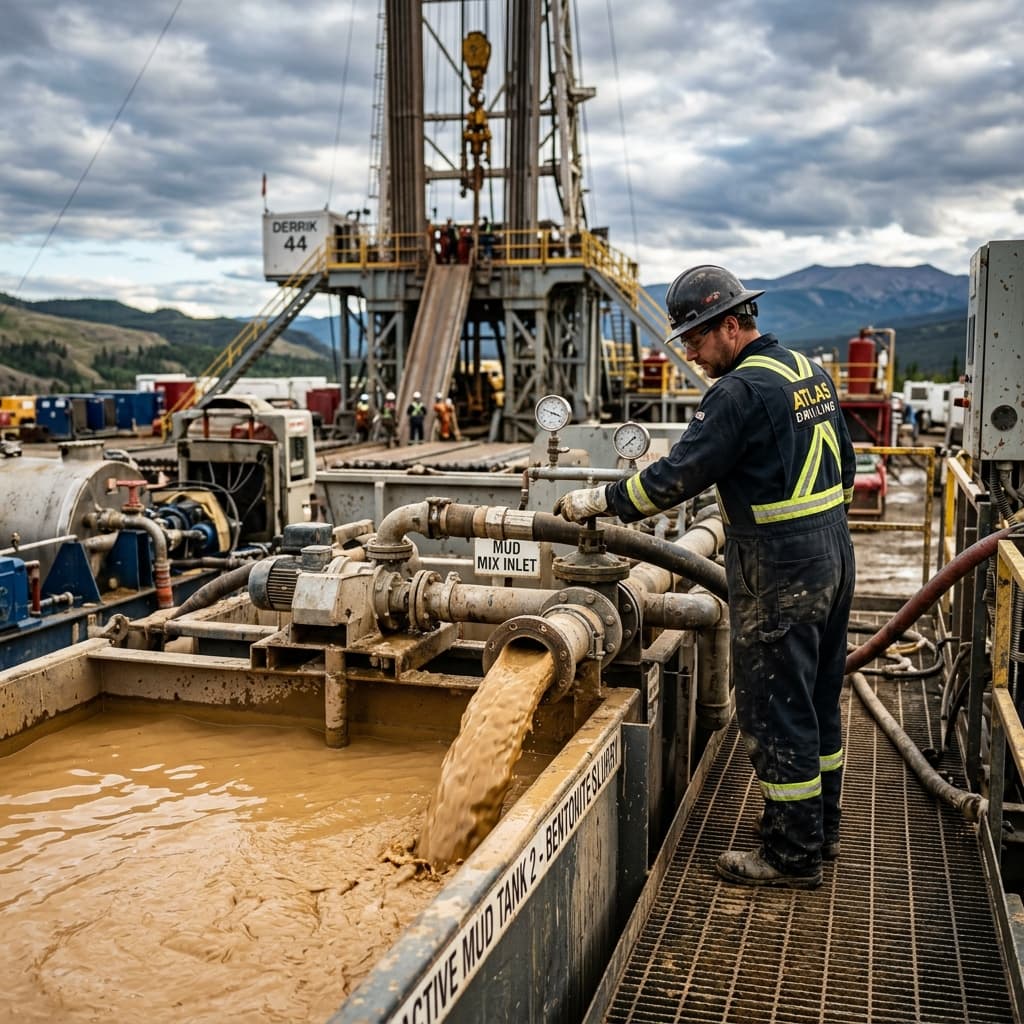
To get the best performance from drilling-grade bentonite at the drilling site:
- Water Quality Check: Ensure the mixing water has low salinity (salt inhibits the swelling of sodium bentonite). The water's hardness should be below 100 ppm, and the pH should ideally be adjusted to between 8.5 and 9.5 using soda ash (Na₂CO₃).
- High-Shear Mixing: Add the bentonite slowly through a mud hopper under high agitation. This ensures the clay clumps break up, exposing each particle to water.
- Pre-hydration Time: Allow the mixed mud to hydrate for 4 to 24 hours before pumping it down the hole. This ensures the clay sheets expand fully, maximizing its viscosity and filtration control.
Sourcing Premium Drilling Bentonite
Using sub-standard bentonite can lead to high fluid loss, hole collapse, and damage to mud pumps. Selecting a supplier that guarantees API Spec 13A compliance is critical to the success of any drilling operation.
Marjaan Minerals is a trusted supplier of API Spec 13A certified drilling bentonite, sourced from premium deposits in Kutch, Gujarat. We ensure excellent viscosity, low fluid loss, and minimal grit for domestic and international drilling operations.