The global steel industry relies on iron ore as its primary raw material. However, during mining and processing, a significant portion of the ore is reduced to fine powder (fines). These fines cannot be loaded directly into a blast furnace because they would choke the airflow, causing unstable furnace operations.
To reclaim these fines, they are mixed with water and a binder, rolled into marble-sized spheres, and baked at high temperatures. This process is called iron ore pelletization, and its primary binding agent is pelletizing grade bentonite.
This technical article explains how bentonite functions in iron ore pelletization, the mechanical properties required for pelletizing clay, and the chemical specifications required by modern steelmakers.
The Pelletization Process: From Fines to Blast Furnace Feed
Iron ore pelletizing is a three-step metallurgical process:
- Mixing: Iron ore concentrate (fines) is mixed with bentonite (typically 0.5% to 1.0% by weight) and water (typically 8% to 10% moisture content).
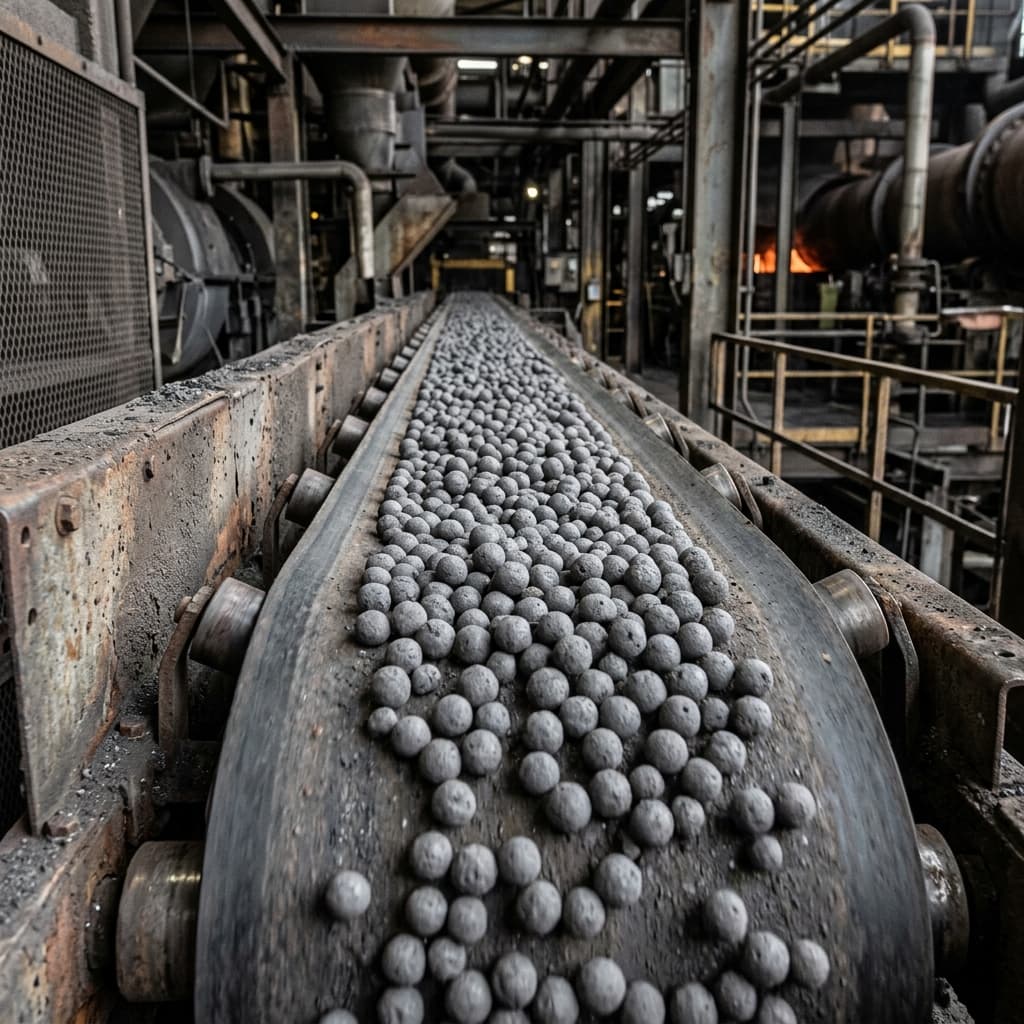
- Balling (Green Pellet Formation): The mixture is fed into rotating balling discs or drums. The capillary forces of the water, combined with the binding strength of the hydrated bentonite, cause the fines to roll and grow into spheres (typically 9 to 16 mm in diameter). These are called green pellets.
- Induration (Baking): The green pellets are dried, preheated, and then fired in an induration furnace at temperatures between 1,200°C and 1,350°C. This vitrifies the iron ore particles, hardening the pellets so they can withstand handling and transport.
How Bentonite Functions as a Pellet Binder
Bentonite serves two critical functions during the pelletization process:
- In Green Pellets (Wet State): The hydrated bentonite clay forms a sticky film around the iron ore particles. This film buffers the moisture within the pellet, providing plasticity and elasticity. This ensures the green pellets can survive dropping from conveyor belts without fracturing.
- In Dry Pellets (Dried State): As the pellets travel through the drying zone of the induration furnace, water evaporates. The bentonite clay dehydrates, forming rigid ceramic bridges between the iron ore grains. This provides the dry strength needed to prevent the pellets from crushing under the weight of the material bed in the furnace.
Critical Physical Parameters for Pelletizing Bentonite
Steelmakers test several physical parameters to ensure the clay performs consistently:
1. Drop Number (Green Pellet)
This is the number of times a green pellet can be dropped from a height of 45 cm onto a steel plate before cracking.
- Typical Requirement: Minimum 4 to 6 drops.
- Significance: Higher drop numbers ensure the pellets do not break during transfers along conveyor belts.
2. Green Compressive Strength (GCS)
The force required to crush a wet green pellet.
- Typical Requirement: Minimum 1.0 to 1.5 kg/pellet.
3. Dry Compressive Strength (DCS)
The force required to crush a dried pellet before firing.
- Typical Requirement: Minimum 3.0 to 5.0 kg/pellet.
- Significance: Prevents pellet degradation in the drying furnace zone.
4. Moisture Absorption (Water Plate Absorption)
The speed and volume of water the dry bentonite can absorb. High moisture absorption allows the clay to quickly distribute water throughout the iron ore mixture, ensuring uniform pellet growth.
The Chemical Challenge: Controlling Silica and Alumina
In metallurgy, silica (SiO₂) and alumina (Al₂O₃) are considered impurities. They form slag in blast furnaces, which increases coke consumption and lowers furnace efficiency.
- The Dilemma: Bentonite is an aluminum silicate mineral, meaning it consists of silica and alumina.
- The Solution: Steelmakers require bentonite with the highest possible binding efficiency, allowing them to use the lowest possible dosage (e.g., 0.5% instead of 1.0%). They also require bentonite with low silica and alumina impurities, keeping the overall chemistry of the iron ore pellets within specification.
Conclusion: Sourcing High-Performance Pelletizing Clays
As steel foundries optimize for efficiency and lower emissions, the quality of raw materials has become more critical. Using low-grade bentonite increases slag and lowers pellet strength, resulting in higher waste.
Marjaan Minerals manufactures high-grade sodium bentonite tailored for iron ore pelletization. Our product provides high green and dry strength at low dosages, helping steel manufacturers optimize blast furnace operations.