
Bentonite clay is a highly active, complex mineral. Translating raw, wet clay from the earth into a high-performance additive that meets strict API Spec 13A or AFS foundry standards requires a precise, controlled manufacturing process.
If the clay is dried too fast, ground to the wrong size, or activated incorrectly, its molecular structure can degrade, rendering it useless for industrial applications.
This technical guide covers the step-by-step industrial bentonite manufacturing process, from open-cast mining to milling, quality control, and export.
The conversion of crude bentonite into a refined powder follows a structured, multi-phase process: open-cast mining, weathering & solar drying, sodium activation (if required), fine pulverization, quality control testing, and packaging & shipping.
1. Open-Cast Mining and Selective Excavation
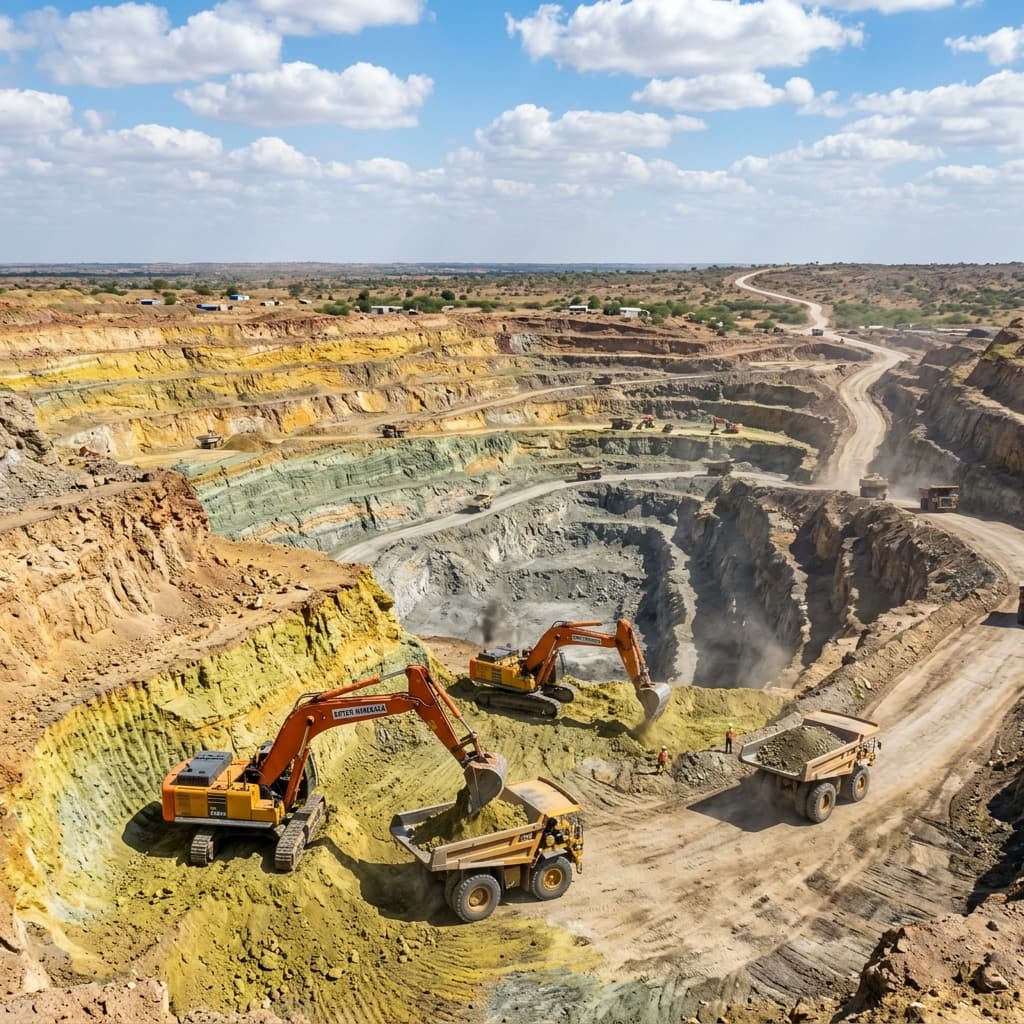
Bentonite deposits are typically found near the surface in horizontal beds. Open-cast (open-pit) mining is the most efficient extraction method:
- Overburden Removal: Excavators remove the top layers of soil and non-clay rocks (overburden) to expose the bentonite beds.
- Selective Mining: Bentonite beds can vary in quality and dominant cation (sodium or calcium) within the same mine. Skilled operators selectively mine the clay layers based on field inspections and pre-drilled core test data.
- Stockpiling: The excavated crude clay is stockpiled by grade at the mine site. At this stage, the raw clay is wet, containing 30% to 45% moisture.
2. Solar Weathering & Drying
Before the clay can be ground, its moisture content must be reduced to between 8% and 12%.
- The Solar Method: In regions with hot, dry climates (such as Kutch, Gujarat), the crude clay is spread over large drying fields (beds). Tractor-drawn harrows turn the clay regularly to expose it to the sun and wind.
- Why Solar Drying? This natural drying process uses no fossil fuels and drying occurs slowly. Rapid, high-temperature drying in rotary kilns can overheat the clay, causing it to lose its chemically bound interlayer water (dehydroxylation). This permanently damages its swelling and binding capabilities. Solar drying preserves the montmorillonite crystal structure.
3. Sodium Activation (Ion Exchange)
For calcium bentonite deposits, a sodium activation step is required to swap calcium ions (Ca²⁺) for sodium ions (Na⁺):
- Soda Ash Addition: Dry sodium carbonate (Na₂CO₃, or soda ash) is added to the wet clay, typically at a ratio of 2% to 5% by weight.
- Homogenization: The clay and soda ash mixture is processed through an extruder or pug mill. The mechanical mixing and moisture force the sodium ions to displace the calcium ions in the clay's interlayer space.
- Aging: The activated clay is stockpiled to allow the ion exchange reaction to go to completion.
4. Fine Pulverization and Classification
Once the clay is dried and cured, it is transported to the processing plant for milling:
- Crushing: Jaw crushers break down large clay lumps into smaller pieces (under 25 mm).
- Milling: The crushed clay is fed into Raymond roller mills, hammer mills, or vertical roller mills. In these mills, heavy rollers grind the clay against a ring.
- Air Classification: An air classifier at the top of the mill controls particle size. Fine particles are carried out by the airflow, while larger particles fall back down to be ground further.
- Custom Sizing: The mill is adjusted to produce the target particle size:
- Foundry/Drilling Grades: Fine powder, typically 95% passing through a 200 mesh (75-micron) screen.
- Civil/Construction Grades: Granular bentonite (1–3 mm) or fine powders.
5. Laboratory Quality Control Testing
Every batch of processed clay is tested in an in-house laboratory to confirm compliance with customer and industry specifications:
- Moisture Testing: Confirms moisture is between 8% and 12% to prevent clumping while ensuring the clay is not over-dried.
- Swell Index (ASTM D5890): Verifies the clay's expansion capability in water.
- Rheology Testing (API Spec 13A): Rotational viscometers measure dial readings at 600 rpm and 300 rpm to calculate Yield Point (YP) and Plastic Viscosity (PV).
- Fluid Loss (API Filter Press): Measures the filtrate volume under 100 psi of pressure to confirm the clay's sealing performance.
- Green Strength (AFS Standards): Rammed sand mixtures are tested for Green Compression Strength (GCS) and Wet Tensile Strength (WTS) for foundry customers.
6. Packaging, Warehousing, and Export Dispatch
Once approved by quality control, the bentonite is packaged and prepared for shipping:
- Packaging Options:
- Jumbo Bags: 1.0 to 1.25 Metric Ton polypropylene bags with inner polyethylene liners to block moisture.
- Small Bags: 25 kg or 50 kg multi-walled paper or laminated plastic bags, palletized and shrink-wrapped.
- Bulk: Dispatched in pneumatic bulk tankers for direct vessel loading.
- Storage: Packaged clay is stored in dry, ventilated warehouses to prevent moisture absorption.
- Export Logistics: The finished product is transported to local ports (such as Mundra or Kandla) for container loading or dry bulk vessel shipping to international markets.
Conclusion: Quality from Mine to Market
Producing high-performance industrial bentonite requires strict quality control at every stage of the manufacturing process. From selective mining and solar drying to fine milling and lab testing, each step is critical to delivering a consistent product.
Marjaan Minerals operates modern processing facilities in Gujarat, India. We manage the entire bentonite manufacturing process from mining to export, ensuring our products meet international API and AFS standards.