
Bentonite is a critical process additive used in drilling, civil engineering, metal casting, and steel manufacturing.
Because bentonite is a natural mineral, its properties can vary significantly between deposits and batches. Using substandard clay can lead to stuck drill pipes, casting defects, or weak steel pellets.
To protect your operations, procurement managers must understand key bentonite quality standards and verify supplier specifications.
This guide outlines the critical quality parameters to evaluate when sourcing industrial bentonite.
Why Quality Matters
Substandard bentonite containing high levels of impurities (such as quartz sand, gypsum, or calcite) will underperform in industrial applications.
- In Drilling: Low-purity clay yields insufficient viscosity, leading to poor cuttings transport and wellbore collapse.
- In Foundries: Impurities lower the melting point of green sand molds, causing the sand to fuse to the metal surface and creating casting defects.
- In Pelletizing: Poor binding capacity requires higher clay dosages, which introduces unwanted silica impurities into the steel furnace.
Swelling Index
The swelling index measures the volume of water the clay can absorb relative to its dry weight.
- Test Method (ASTM D5890): 2.0 grams of dry clay is dusted into a 100 ml graduated cylinder filled with deionized water in small increments over 2 hours. The swelled volume is recorded after 24 hours.
- Standards: High-quality natural sodium bentonite typically yields a swell index of minimum 25 ml to 30 ml per 2 grams. Low-swelling calcium bentonite yields under 10 ml.
Moisture Content
Controlling moisture is critical to product handling, storage, and milling:
- Standards: Reusable industrial bentonite powders should have a moisture content between 8% and 12% by weight.
- Significance: If the moisture is too high, the powder will clump and aggregate during storage. If the clay is over-dried (under 5% moisture), the interlayer crystal structure can dehydrate permanently (dehydroxylation), reducing its swelling capacity when mixed with water.
Viscosity
Viscosity determines the clay's ability to thicken water and carry solids:
- Test Method: Rotary viscometers measure the shear stress of a clay-water suspension at 600 rpm and 300 rpm.
- Standards: API-grade drilling clays must yield a dial reading of minimum 30 at 600 rpm. Foundries and civil engineering projects also have specific viscosity targets measured by Marsh Funnels.
pH Value
The pH of the clay suspension affects particle dispersion and gel stability:
- Standards: High-quality sodium bentonite suspensions typically have an alkaline pH between 8.5 and 10.0.
- Significance: If the pH is too low (acidic), the clay platelets can agglomerate, reducing suspension stability and viscosity. Soda ash (sodium carbonate) is often added to adjust the pH of water to optimize swelling.
API Compliance
For drilling applications, the American Petroleum Institute (API) regulates clay performance under the API Spec 13A (ISO 13500) standard.
To be certified as API Grade Bentonite, the clay must meet specific criteria for rheology, filtrate volume (maximum 15.0 cm³), moisture content, and grit content (maximum 4.0% of particles larger than 75 microns).
Quality Testing Methods
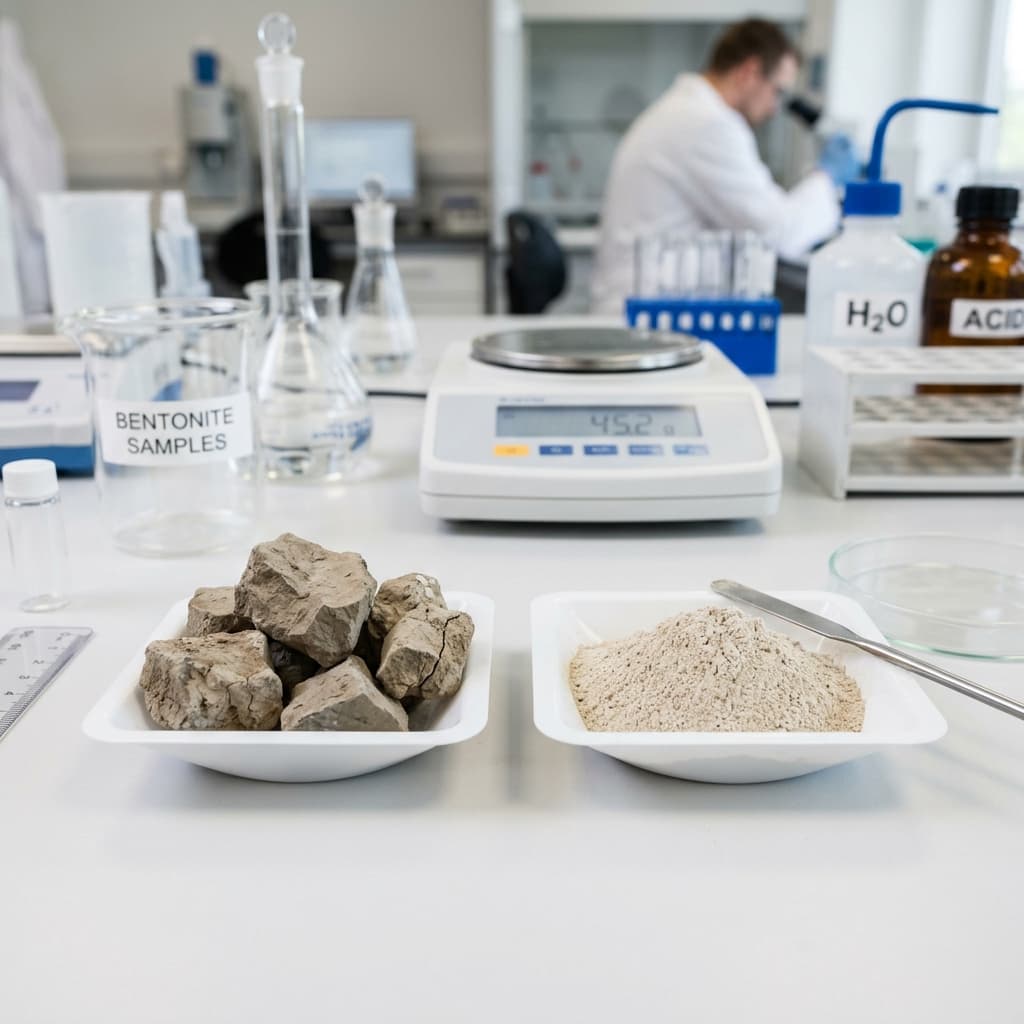
A reliable supplier should operate an in-house laboratory to test every batch of clay. Critical testing equipment includes:
- Rotational Viscometers: To measure plastic viscosity, yield point, and gel strength.
- Filter Presses: To test filtrate volume and filter cake thickness under pressure.
- Wet Screen Washers: To measure grit and sand content.
- Muffle Furnaces: To test moisture loss and dehydroxylation points.
Conclusion
Understanding bentonite quality standards enables buyers to make informed purchasing decisions and avoid operational failures.
Marjaan Minerals maintains strict quality control systems. We test and certify every batch in our modern laboratory, providing full traceability and consistent compliance with international API and AFS standards.