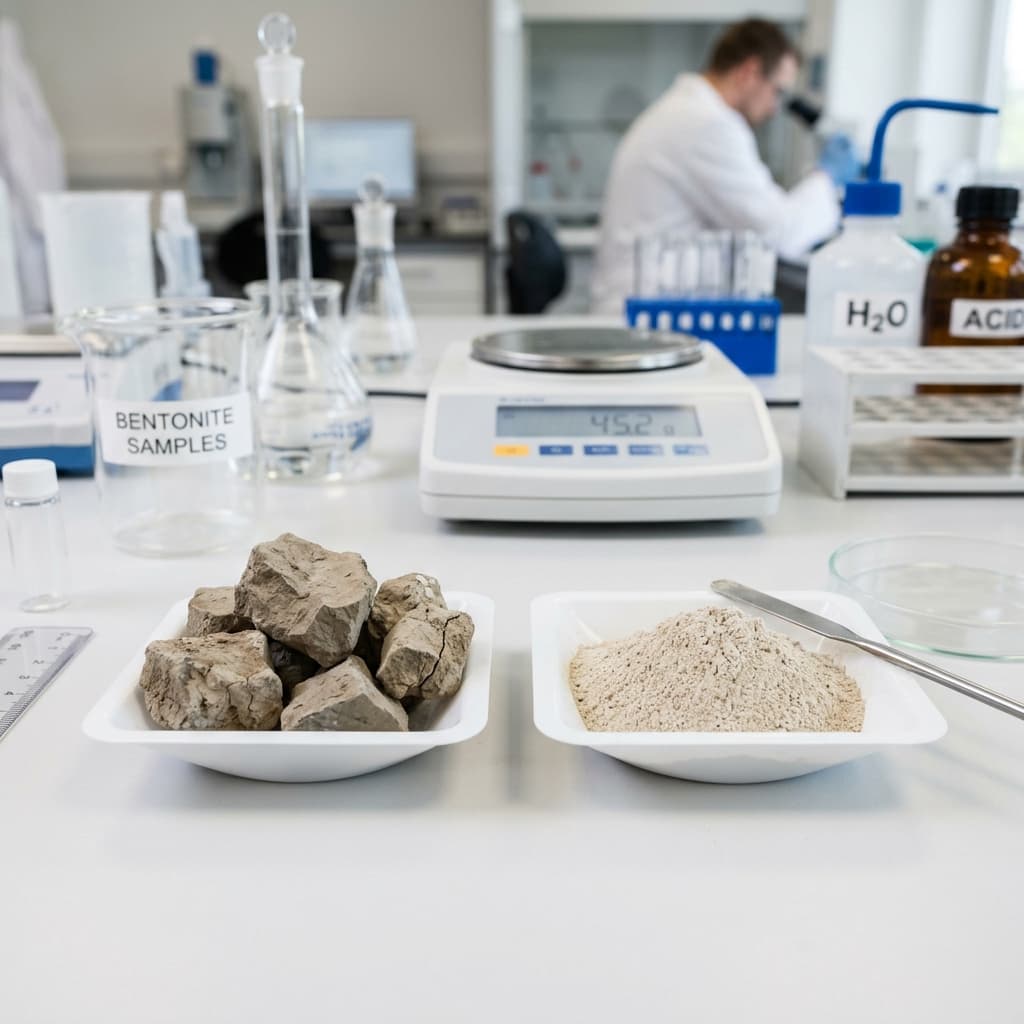
Bentonite clay is not a single, uniform mineral. It is a category of naturally occurring volcanic clays that varies dramatically depending on its geological origin and geographic deposit location.
The two primary commercial types—sodium bentonite and calcium bentonite—behave in completely different ways when exposed to water. Choosing the wrong type of clay can cause catastrophic failures in drilling operations, foundry casting, and civil engineering projects.
This technical guide breaks down the chemical, structural, and practical differences between sodium and calcium bentonite, highlighting their respective industrial applications and explaining the process of sodium activation.
The Chemical Core: Cations and Crystallography
To understand the difference, we must look at the clay's atomic structure. Both sodium and calcium bentonites consist mainly of montmorillonite, a 2:1 expanding sheet silicate.
Because of volcanic weathering and mineral replacement (isomorphous substitution), the clay sheets have a permanent negative charge. This negative charge is neutralized by cations residing in the interlayer space between sheets.
In Sodium Bentonite, single-charged sodium ions (Na⁺) allow water molecules to easily enter and push the plates apart, resulting in high swelling.
In Calcium Bentonite, double-charged calcium ions (Ca²⁺) act as a strong electrostatic bridge, locking the sheets together and restricting swelling.
Why Sodium Bentonite Swells (High-Swelling Clay)
In sodium bentonite, the dominant exchangeable cation is the sodium ion (Na⁺). Sodium is a monovalent cation with a relatively large hydrated ionic radius. It exerts a weak electrostatic pull on the surrounding clay sheets. When exposed to water, water molecules easily penetrate the interlayer spaces, pushing the plates far apart.
- Swelling Potential: Can expand 15 to 20 times its original dry volume.
- Thixotropy: Forms stable, gel-like colloidal suspensions.
Why Calcium Bentonite Doesn't Swell (Low-Swelling Clay)
In calcium bentonite, the dominant exchangeable cation is the calcium ion (Ca²⁺). Calcium is a divalent cation, meaning it has a +2 positive charge. This higher charge density exerts a much stronger electrostatic attraction, binding the negatively charged clay sheets tightly together. Water molecules struggle to push these sheets apart.
- Swelling Potential: Typically expands only 2 to 3 times its dry volume.
- Absorbency: Excellent capacity to adsorb organic compounds, oils, and toxins due to its high porosity, despite the lack of volumetric swelling.
Head-to-Head Comparison Table
| Property / Feature | Sodium Bentonite (Natural) | Calcium Bentonite (Natural) |
|---|---|---|
| Dominant Cation | Sodium (Na⁺) | Calcium (Ca²⁺) |
| Swelling Capacity | High (15x to 20x dry volume) | Low (2x to 3x dry volume) |
| Water Absorption | Up to 500% to 800% of dry weight | Up to 100% to 200% of dry weight |
| Colloidal Suspension | Highly stable, thixotropic gel | Unstable, settles rapidly |
| Primary Industrial Use | Drilling mud, foundry green sand, waterproofing | Oil clarification, cat litter, cosmetics |
| Cation Exchange Capacity (CEC) | High (80–120 meq/100g) | High (60–100 meq/100g) |
| Liquid Limit | Very high (typically > 300%) | Low to moderate (typically < 150%) |
Industrial Applications: Where to Use Which Type
The differences in physical behavior dictate which type of clay is used in various industrial sectors.
Sodium Bentonite Applications
Because of its unique swelling and gelling properties, sodium bentonite is the preferred option for heavy industry and engineering:
- Drilling Applications: Essential in oil, gas, and civil engineering drilling. It creates high-viscosity drilling fluids (muds) that transport rock cuttings out of the borehole and form a thin, impermeable filter cake on the borehole walls.
- Foundry Industry Binder: Combined with silica sand in green sand molds for metal casting. Its high thermal stability and binding strength ensure the mold retains its shape when molten iron or steel is poured in.
- Piling & Civil Construction: Used in diaphragm wall construction and drilling slurry because it stabilizes soil excavations, preventing cave-ins.
- Pond and Landfill Sealing: Used as an environmental sealant. When sodium bentonite swells, it fills voids in the soil, creating a highly impermeable barrier that blocks water and contaminants.
Calcium Bentonite Applications
Calcium bentonite is highly valued for its chemical surface characteristics:
- Clarification and Bleaching of Oils: Used in refining edible oils, fats, and biodiesels. Its active surface areas adsorb color pigments, trace metals, and chemical impurities.
- Cat Litter (Non-Clumping & Clumping): Highly absorbent, making it a key component in animal bedding and deodorizing litters.
- Cosmetics & Medical Therapy: Known as "healing clay," it is used in facial masks and detoxification products because it absorbs toxins and excess sebum from skin pores.
- Paper Industry: Used as a pitch control agent and retention aid in papermaking.
The Sodium Activation Process (Soda Ash Modification)
In regions where natural sodium bentonite is scarce, calcium bentonite is converted into a swelling variety through sodium activation (or ion exchange).
Ca-Bentonite + Na₂CO₃ ➔ Na-Bentonite + CaCO₃
- Reagent Addition: Calcium bentonite is milled and mixed with sodium carbonate (Na₂CO₃, commonly known as soda ash), typically at a concentration of 2% to 5% by weight.
- Moisture & Curing: Moisture is added, and the clay is left to cure or run through an extruder. Under these conditions, the sodium ions (Na⁺) displace the calcium ions (Ca²⁺) within the clay interlayer.
- Result: The calcium ions precipitate out as calcium carbonate (CaCO₃), and the clay gains higher swelling and rheological properties, resembling natural sodium bentonite.
While activated bentonites are effective for foundry binding and certain construction projects, natural sodium bentonites (such as those mined in Wyoming, USA, or Kutch, Gujarat, India) are often preferred for deep, high-pressure drilling applications because their thermal stability and viscosity profiles do not degrade over time.
Summary: Making the Right Choice
Choosing between sodium and calcium bentonite depends entirely on whether your project requires volumetric expansion & fluid viscosity or surface absorption & clarification.
- Select Sodium Bentonite for drilling fluids, soil sealing, tunneling, piling, and casting.
- Select Calcium Bentonite for oil purification, chemical filtration, agricultural carriers, and wellness products.
As a premium sodium bentonite supplier, Marjaan Minerals provides both high-yield natural sodium bentonite and custom-activated grades to meet the rigorous specifications of global industries.