
Bentonite for Electrical Substation Earthing
Electrical substations are critical nodes in power transmission and distribution networks. A well-designed and properly installed earthing (grounding) system is essential to ensure personnel safety, protect equipment, and allow fault currents and lightning energy to dissipate safely into the earth.
In many substation sites, native soil conditions make it difficult to achieve the low and stable earth resistance required by standards. Bentonite, used as an earthing compound or ground enhancement material, has become a trusted solution for improving substation grounding performance.
This article explains why bentonite is particularly suitable for electrical substation earthing and outlines the key technical and practical considerations.
Why Substation Grounding Matters
Substation earthing systems must:
- Limit touch and step voltages to safe levels during fault conditions
- Provide a low-impedance path for fault currents and lightning discharges
- Protect transformers, switchgear, control systems, and personnel
- Maintain performance over decades with minimal maintenance
High soil resistivity, seasonal moisture variation, or rocky ground can cause earth resistance to rise above acceptable limits. Failure to control these factors increases safety risks and can lead to equipment damage or operational disruptions.
Role of Earthing Compounds
Earthing compounds (also called ground enhancement materials) are placed around electrodes and conductors to reduce contact resistance and lower overall system resistance.
Bentonite performs this role by:
- Creating a low-resistivity zone around the metal components
- Improving physical and electrical contact between the electrode and the soil
- Retaining moisture in the critical interface zone
- Remaining stable over long periods without leaching aggressive chemicals
Unlike traditional salt-based compounds, bentonite does not rely on soluble salts that can wash away or accelerate corrosion.
Ground Grid Applications
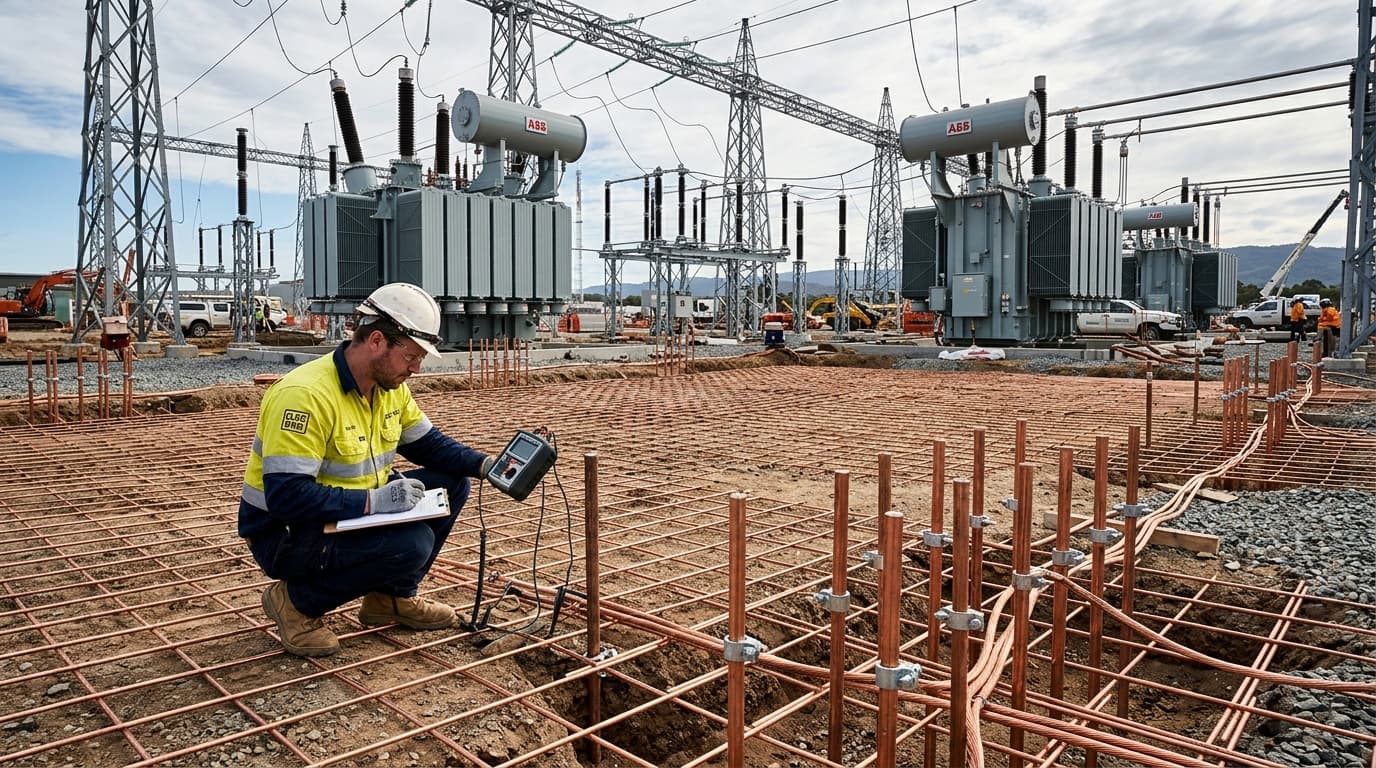
Most substations use a buried ground grid (mesh) made of copper or copper-clad conductors, often combined with vertical earth rods at strategic locations.
Bentonite is commonly applied in the following ways:
- As backfill around vertical earth rods driven or drilled at grid intersections
- As a continuous or intermittent layer surrounding horizontal grid conductors in trenches
- Around riser connections and equipment grounding points
- In areas of the grid where soil resistivity is particularly high
By encapsulating key parts of the grid, bentonite increases the effective size of the conductors and improves current dissipation into the surrounding soil.
Electrode / Backfill Interaction
The interface between the metal electrode and the backfill material is critical.
When bentonite is properly hydrated:
- It swells and forms a dense, paste-like mass that eliminates air gaps
- It creates continuous, intimate contact with the electrode surface
- It increases the effective diameter of rods and the surface area of conductors
- It provides a stable ionic pathway for current flow
This improved contact significantly reduces the contact resistance component of the overall earth resistance.
Soil Conditions
Substation sites vary widely. Bentonite is especially valuable in:
- High-resistivity soils (sandy, gravelly, or rocky)
- Sites with large seasonal moisture variation
- Locations where deep rod driving is restricted by rock or hard strata
- Areas where achieving the design resistance with native soil alone would require an impractically large grid
In lower-resistivity clay soils, bentonite may still be used selectively at critical points to enhance performance and long-term stability.
Moisture Retention
Moisture content has a dominant influence on soil resistivity. Dry soil can have resistivity many times higher than the same soil when moist.
Sodium bentonite’s ability to absorb and retain large quantities of water helps maintain a conductive environment around the electrodes even during prolonged dry periods. This reduces seasonal fluctuations in earth resistance — a major advantage for substations that must meet strict safety criteria year-round.
Long-Term Stability
Substation earthing systems are designed for service lives of 30–40 years or more. Materials used in the system must remain effective throughout this period.
Bentonite offers excellent long-term stability because:
- It does not leach away like soluble salts
- Its swelling structure remains largely intact once installed
- It does not significantly change its chemical or physical properties over time
- It helps protect electrodes from aggressive soil chemistry
This stability translates into more predictable performance and lower lifetime maintenance requirements.
Installation Considerations
Successful use of bentonite in substations depends on correct installation:
- Ensure complete encapsulation of rods and, where specified, horizontal conductors
- Mix the bentonite with clean water to the recommended consistency (slurry or thick paste)
- Avoid air pockets by proper placement and, if necessary, light compaction
- Follow the design quantities — under-application reduces the effective diameter and benefits
- Protect the installed bentonite from excessive drying before backfilling with native soil
Coordination between the civil and electrical teams during trench and borehole work is important to achieve uniform coverage.
Quality Requirements
For substation applications, only high-quality earthing-grade bentonite should be used. Key requirements typically include:
| Parameter | Recommended Characteristic |
|---|---|
| Base material | Sodium or sodium-activated montmorillonite |
| Free swelling index | ≥ 20–25 ml (2 g / 100 ml) |
| Moisture content (as supplied) | 10–14% |
| pH (2% slurry) | 8.0 – 10.0 |
| Particle size | High percentage passing 200 mesh |
| Purity / grit content | Low |
| Consistency | Tight batch-to-batch control |
| Documentation | Technical Data Sheet + Certificate of Analysis |
Using material that meets these criteria helps ensure the grounding system performs as designed over its full service life.
Conclusion
Bentonite is a proven and effective material for enhancing the performance of electrical substation earthing systems. By improving electrode contact, retaining moisture, lowering local resistivity, and providing long-term stability, it helps substations meet stringent safety and operational requirements — even in challenging soil conditions.
When specified and installed correctly, high-quality earthing-grade bentonite contributes to safer, more reliable, and lower-maintenance substation grounding.
Looking for a reliable solution for your next substation project?
Contact the Marjaan Minerals technical team for product specifications, application guidance, and supply support.