
Bentonite Slurry for Piling: Preparation, Properties and Testing
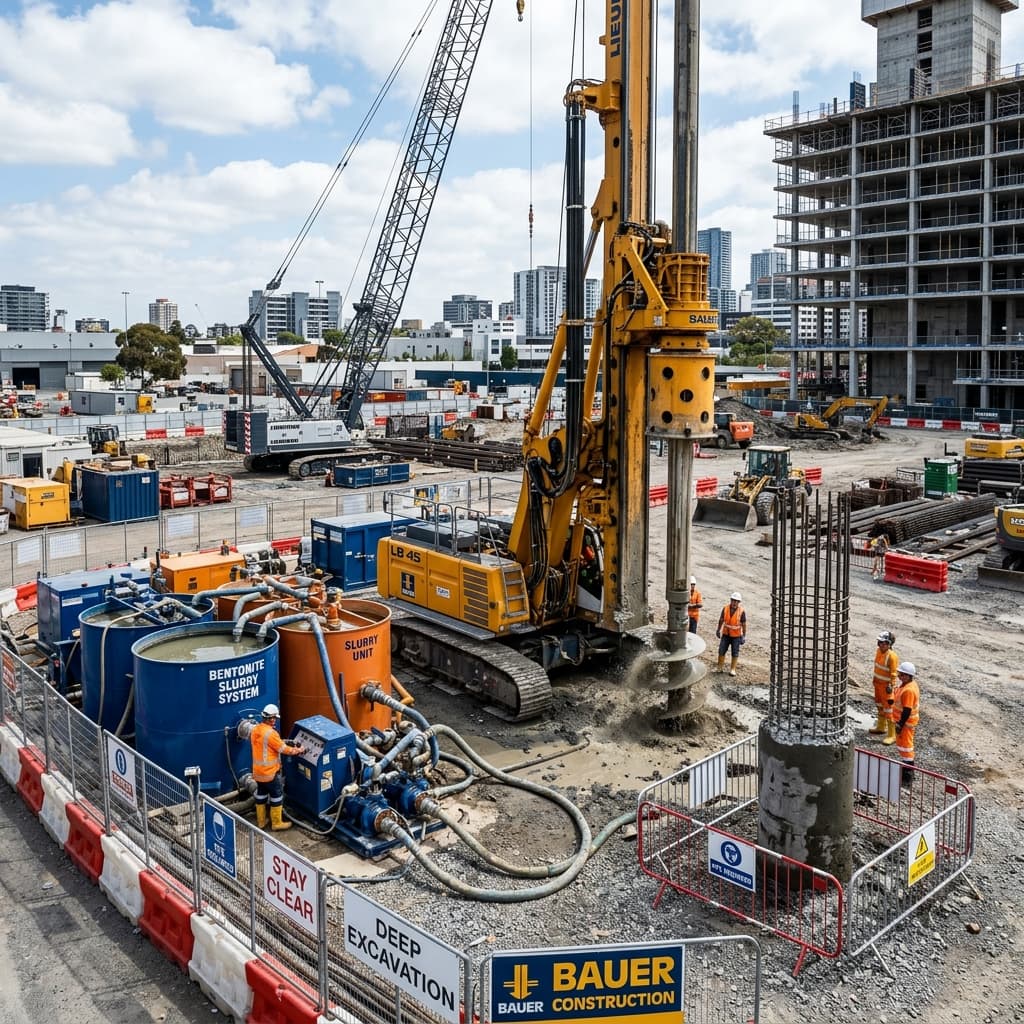
Bentonite slurry is a critical component in the construction of bored piles and diaphragm walls. It stabilises the excavated borehole or trench, supports the surrounding soil, and allows safe placement of reinforcement and concrete.
Using the correct grade of bentonite and maintaining proper slurry properties throughout the process are essential for successful piling operations. Poor slurry quality can lead to borehole collapse, contamination of concrete, reduced pile capacity, or costly delays.
This guide covers the purpose of bentonite slurry, preparation methods, key properties, testing requirements, and practical site troubleshooting.
Purpose of Slurry
In bored piling and diaphragm wall construction, bentonite slurry serves several important functions:
- Stabilises the borehole or trench walls by exerting hydrostatic pressure
- Forms a thin filter cake on the excavated surface that reduces fluid loss into the ground
- Suspends cuttings and prevents them from settling
- Allows clean displacement by concrete during tremie placement
- Protects the fresh concrete from contamination by soil and groundwater
Without effective slurry support, many soil types would collapse before reinforcement and concrete could be placed.
Sodium Bentonite
High-quality sodium bentonite (or sodium-activated bentonite) is preferred for piling slurry.
Sodium montmorillonite provides:
- High swelling capacity
- Good rheological properties (viscosity and gel strength)
- Effective filter cake formation
- Stable suspension characteristics
Calcium bentonite generally performs poorly in this application due to lower swelling and weaker rheology. Always specify a piling-grade or drilling-grade sodium bentonite suitable for civil engineering use.
Water Quality
The quality of mixing water has a direct impact on slurry performance.
Recommended guidelines:
- Use clean, fresh water (potable water is ideal)
- Avoid seawater or highly saline water unless special salt-resistant bentonite is used
- Check for excessive hardness, chlorides, or contaminants
- Water temperature influences hydration rate (very cold water slows hydration)
Poor water quality can reduce swelling, increase required bentonite dosage, and affect viscosity and filtration properties.
Mixing Process
Proper mixing is essential to fully disperse and hydrate the bentonite.
Typical steps:
- Fill the mixing tank with the required volume of clean water.
- Start the high-shear mixer or colloidal mixer.
- Gradually add bentonite powder at a controlled rate to avoid lumping.
- Continue mixing until a uniform slurry is achieved.
High-shear or colloidal mixers are strongly preferred over simple paddle mixers because they break down particle aggregates more effectively and produce better slurry properties at lower bentonite concentrations.
Hydration Time
Bentonite does not reach full performance immediately after mixing.
- Minimum hydration time is usually 4–6 hours.
- Many specifications require 12–24 hours of hydration (or overnight) before the slurry is used in the excavation.
- During hydration, the montmorillonite particles fully expand and develop optimum viscosity and gel strength.
Using slurry before adequate hydration often results in poor stabilisation and higher fluid loss.
Slurry Properties
The performance of bentonite slurry is controlled by several measurable properties. These must be maintained within specified limits throughout the excavation and concreting process.
Density
- Typical range for fresh slurry: 1.03 – 1.10 g/cm³
- Higher density may be used in unstable ground, but excessive density increases the risk of concrete contamination and makes displacement more difficult.
- Density rises as sand and cuttings become suspended in the slurry.
Viscosity
- Measured with a Marsh funnel.
- Typical acceptable range: 30 – 50 seconds (depending on soil conditions and specification).
- Too low: poor stabilisation and suspension of cuttings.
- Too high: difficult pumping, poor concrete displacement, and risk of trapping slurry.
Sand Content
- Measured by sand content kit.
- Fresh slurry should have very low sand content (ideally < 1%).
- Before concreting, sand content is usually limited to ≤ 4% (some specifications are stricter).
- High sand content increases the risk of soft toes, reduced pile capacity, and difficulty in concrete placement.
Filtration (Fluid Loss)
- Measured with a filter press (API or similar).
- Indicates the ability of the slurry to form a low-permeability filter cake.
- Lower fluid loss is generally better for borehole stability.
- Excessive filtration can lead to thick filter cake or loss of slurry into permeable soils.
Testing Before Concreting
Critical tests are performed on the slurry in the borehole immediately before concrete placement:
| Property | Typical Acceptance Limit | Purpose |
|---|---|---|
| Density | ≤ 1.15 g/cm³ (often stricter) | Ensure clean concrete displacement |
| Marsh viscosity | Within specified range | Proper flow and suspension |
| Sand content | ≤ 3–4% | Avoid soft base and contamination |
| pH | Usually 7–11 | Check for contamination or degradation |
| Temperature | Recorded | Influences other properties |
Desanding and cleaning of the slurry are often required to bring properties back within limits before concreting.
Site Troubleshooting
| Problem | Possible Cause | Corrective Action |
|---|---|---|
| Borehole instability / collapse | Low viscosity or density, poor filter cake | Increase bentonite content, improve hydration, check water quality |
| High sand content | Inadequate desanding, high cuttings | Run desander longer, dilute and re-treat slurry |
| Excessive viscosity | Overdosing, contamination, aging | Dilute with fresh water or fresh slurry |
| High fluid loss | Low-quality bentonite, poor hydration, contaminated water | Use better-grade bentonite, extend hydration, check water |
| Difficulty displacing slurry | Density or viscosity too high | Clean/desand slurry, adjust properties |
| Contaminated slurry (cement, salt, etc.) | Ingress of concrete or groundwater | Discard affected slurry, prepare fresh batch |
Regular testing and proactive management of slurry properties are the best ways to avoid these issues.
Conclusion
Successful use of bentonite slurry in piling depends on selecting the right sodium bentonite, using good-quality water, ensuring thorough mixing and adequate hydration, and maintaining key properties (density, viscosity, sand content, and filtration) within specified limits. Consistent testing — especially before concreting — is essential for quality control.
When these factors are properly managed, bentonite slurry provides reliable borehole support and contributes to high-quality bored piles and diaphragm walls.
Looking for high-performance sodium bentonite for piling applications?
Contact the Marjaan Minerals technical team or explore our range of civil engineering and piling-grade bentonite products for consistent quality and reliable site performance.