
How Bentonite Improves Earthing System Performance
A reliable earthing (grounding) system is essential for electrical safety, equipment protection, and the safe dissipation of fault currents and lightning energy. In many locations, native soil conditions make it difficult to achieve and maintain low earth resistance.
Bentonite, specifically high-quality sodium bentonite used as an earthing compound, is one of the most effective and widely adopted solutions for improving grounding system performance. This article explains exactly how bentonite enhances earthing systems across critical performance parameters.
Understanding Soil Resistivity
Soil resistivity is the primary factor that determines the resistance of an earthing system. It varies widely depending on:
- Soil composition (clay, sand, rock, gravel)
- Moisture content
- Temperature
- Salt and mineral content
High-resistivity soils (common in sandy, rocky, or arid regions) can exceed 500–1,000 Ω·m or more, making it challenging to achieve target earth resistance values (often ≤1 Ω or ≤5 Ω).
Bentonite addresses this by creating a localized zone of much lower resistivity around the electrode — typically in the range of 2–5 Ω·m when properly hydrated.
Improving Electrode-to-Soil Contact
Even in moderately conductive soils, poor physical contact between the earth electrode and the surrounding soil increases contact resistance. Air gaps, loose backfill, or uneven soil can significantly raise the overall system resistance.
When bentonite is installed around an earth rod, plate, or conductor:
- It swells upon hydration (often 10–15 times its dry volume)
- It expands to fill all voids and irregularities
- It forms intimate, continuous contact with both the metal electrode surface and the native soil
This dramatically increases the effective surface area of the electrode and reduces contact resistance — one of the most immediate performance benefits of bentonite.
Superior Moisture Retention
Moisture is the single most influential factor controlling soil resistivity. Dry soil is a poor conductor; moist soil conducts electricity far more effectively.
Sodium bentonite is highly hygroscopic. It can:
- Absorb up to five times its own weight in water
- Retain that moisture for extended periods
- Draw additional moisture from surrounding soil and rainfall
By acting as a permanent moisture reservoir around the electrode, bentonite keeps the critical interface zone consistently conductive even when the surrounding soil dries out.
Stabilizing Seasonal Performance
One of the biggest challenges with conventional earthing systems is seasonal variation. Earth resistance often rises sharply during dry periods and falls after rainfall.
Bentonite significantly reduces these fluctuations:
- The moisture retained within the bentonite layer buffers against seasonal dryness
- Resistance values remain more stable throughout the year
- The system continues to perform reliably during prolonged dry spells
This stability is especially valuable for critical installations such as substations, telecom towers, and industrial plants where consistent low resistance is required year-round.
Reducing Ground Resistance
The combined effect of lower resistivity, improved contact, and sustained moisture leads to a measurable reduction in overall ground resistance.
In practical installations, properly applied bentonite can reduce earth resistance by 30–70% or more compared with native soil backfill, depending on original soil conditions and installation quality. Increasing the effective diameter of an earth rod (for example from 15 mm to 150–200 mm through the bentonite envelope) contributes significantly to this reduction.
How Bentonite Forms a Conductive, Moisture-Retaining Environment
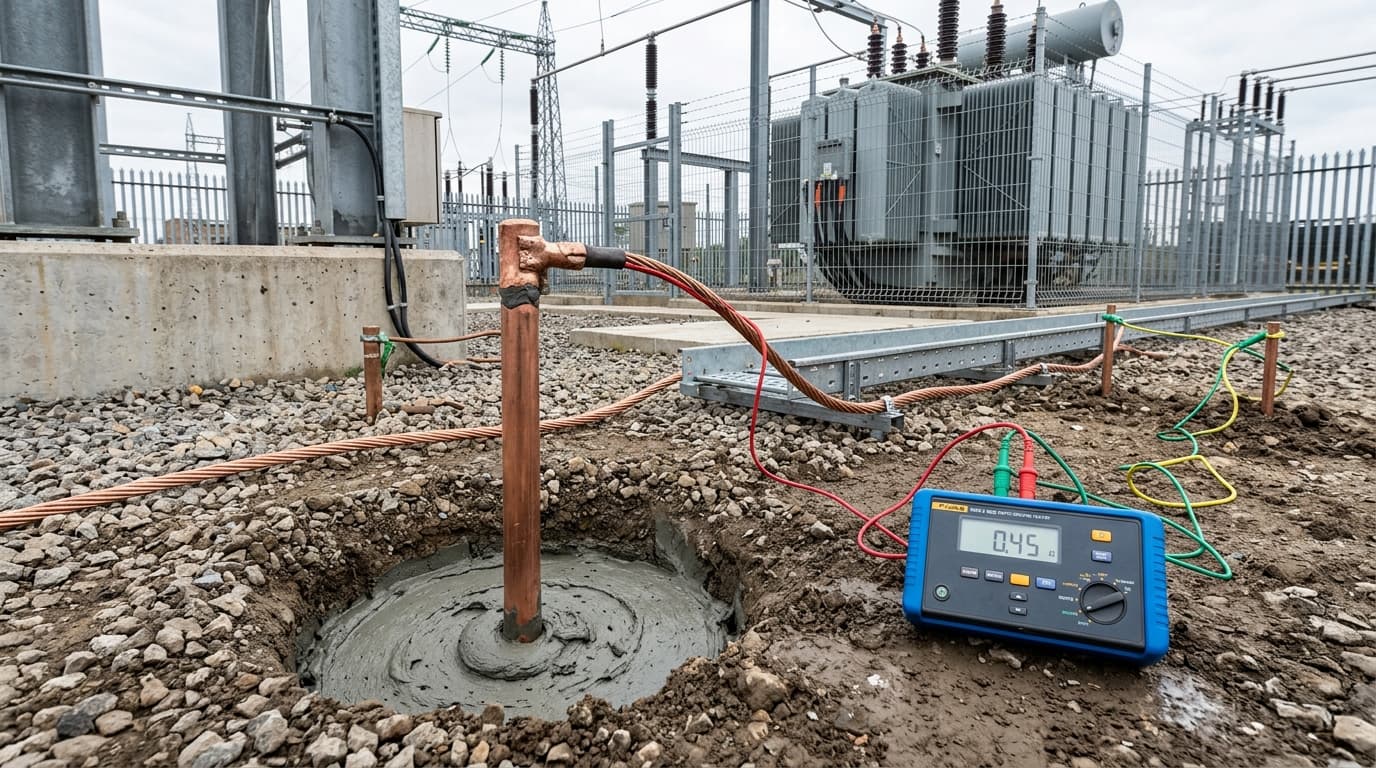
When bentonite is mixed with water and placed around an electrode, the following process occurs:
- Water molecules enter the interlayer spaces of the montmorillonite clay particles.
- The clay swells, forming a dense, gel-like or paste-like mass.
- This mass encapsulates the electrode completely and bonds with the surrounding soil.
- The retained water provides a continuous path for ionic conduction.
- The structure remains stable over time and does not leach or wash away like many chemical compounds.
The result is a durable, low-resistivity, moisture-rich cylinder or envelope surrounding the electrode that functions as an integral part of the earthing system.
Factors Affecting Bentonite Performance
While bentonite is highly effective, several factors influence the final results:
| Factor | Impact on Performance | Recommendation |
|---|---|---|
| Quality of bentonite | Sodium content, swelling index, purity | Use dedicated earthing-grade sodium bentonite |
| Hydration level | Insufficient water reduces swelling and conductivity | Mix thoroughly with adequate clean water |
| Installation method | Incomplete coverage leaves air gaps | Ensure full encapsulation of the electrode |
| Soil conditions | Extremely dry or highly permeable soils may need more material | Assess site conditions before installation |
| Quantity used | Too little material limits the effective diameter | Follow recommended application rates |
| Long-term moisture availability | Areas with very low rainfall may require occasional rehydration | Monitor critical sites if needed |
Proper material selection and correct installation are essential to realize the full performance benefits.
Conclusion
Bentonite improves earthing system performance by simultaneously addressing the three most critical challenges: high soil resistivity, poor electrode contact, and moisture variability. Through its swelling action, moisture retention capability, and low resistivity when hydrated, it creates a stable, conductive environment that keeps ground resistance low and consistent across seasons.
For installations in high-resistivity or variable soil conditions, high-quality earthing-grade bentonite remains one of the most reliable and cost-effective enhancement methods available.
Looking for proven performance?
Contact the Marjaan Minerals technical team for product data, application guidance, and supply support.