
How to Prepare Bentonite Slurry for Bored Piles
Proper preparation of bentonite slurry is essential for the successful construction of bored piles. A well-prepared slurry stabilises the borehole, supports the soil, suspends cuttings, and allows clean concrete placement. Poorly prepared slurry can lead to borehole collapse, high sand content, concrete contamination, or reduced pile performance.
This practical guide explains the correct method for preparing bentonite slurry for bored piles, from equipment selection to quality maintenance and common mistakes to avoid.
Required Equipment
The following equipment is typically required for efficient slurry preparation:
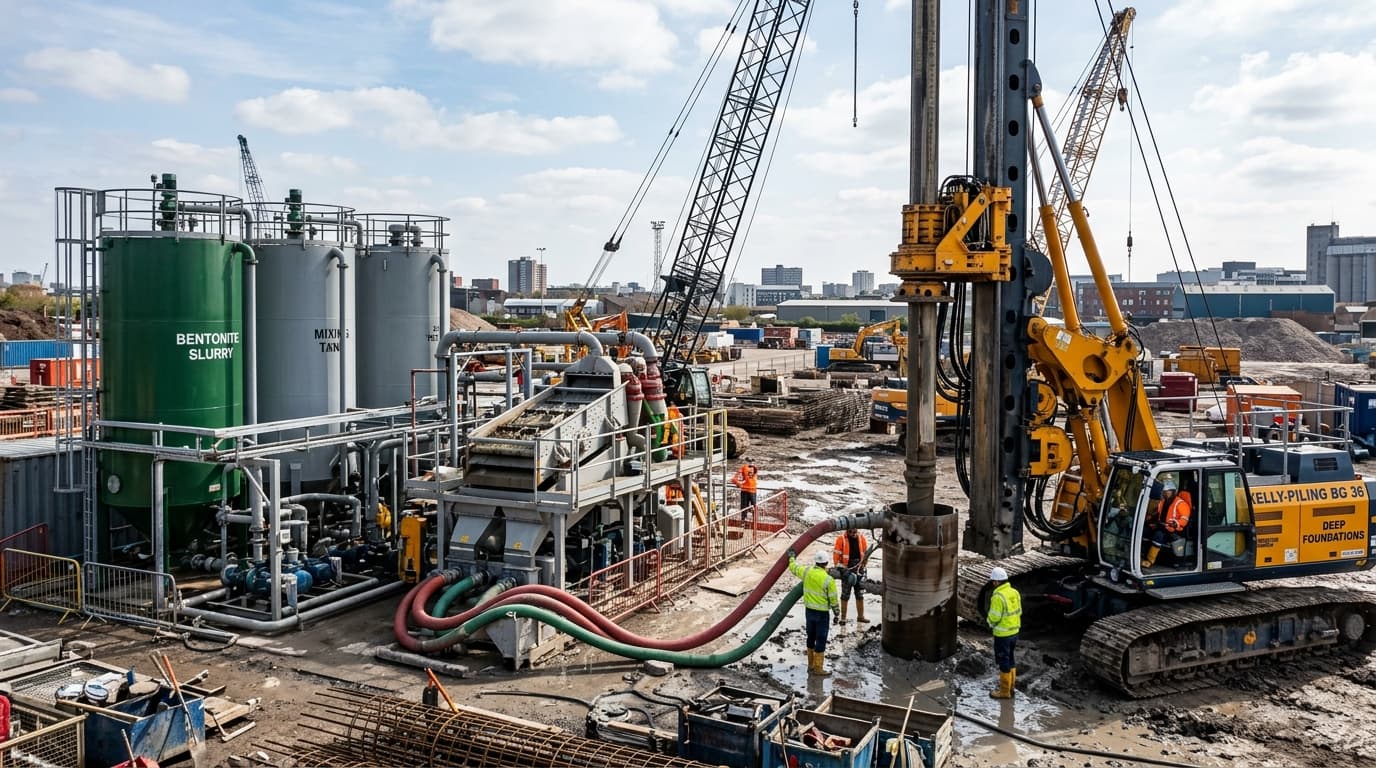
- Mixing tank or tanks (adequate volume for the project)
- High-shear mixer or colloidal mixer (preferred over simple paddle mixers)
- Fresh water supply line
- Bentonite powder storage and feeding system (manual or automated)
- Pumps for transfer and circulation
- Desanding unit (for cleaning used slurry)
- Testing equipment (Marsh funnel, mud balance, sand content kit, pH meter, etc.)
- Storage tanks or ponds for hydrated slurry
High-shear or colloidal mixers produce better dispersion and allow lower bentonite dosages compared with low-shear paddle mixers.
Water Preparation
Water quality directly affects slurry performance.
- Use clean, fresh water (preferably potable).
- Avoid seawater, brackish water, or water with high salinity, hardness, or chemical contamination unless a specially formulated salt-resistant bentonite is used.
- Check water temperature — very cold water slows hydration.
- Fill the mixing tank with the calculated volume of water before adding bentonite.
Good water quality helps achieve target properties at economical bentonite concentrations.
Bentonite Addition
- Use high-quality sodium bentonite suitable for civil engineering / piling applications.
- Calculate the required dosage based on the target density and viscosity (typically 40–80 kg per m³ of water, depending on bentonite grade and soil conditions).
- Add the bentonite powder gradually while the mixer is running.
- Avoid dumping large quantities at once, as this causes lumping and incomplete dispersion.
Controlled, steady addition produces a smoother, more uniform slurry.
Mixing
- Start the high-shear or colloidal mixer before adding bentonite.
- Continue mixing throughout the addition process and for a sufficient period afterwards.
- Aim for complete dispersion of bentonite particles with no visible lumps.
- Mixing time depends on mixer type and batch size, but thorough high-shear mixing is more important than simply long mixing time.
Proper mixing is critical for developing the full swelling and rheological potential of the bentonite.
Hydration
Bentonite slurry requires time to hydrate fully.
- After mixing, allow the slurry to hydrate for a minimum of 4–6 hours.
- Many project specifications require 12–24 hours (or overnight) of hydration before the slurry is used in the borehole.
- During hydration, montmorillonite particles absorb water, swell, and develop optimum viscosity and gel strength.
Using slurry before adequate hydration results in poorer stabilisation and higher fluid loss.
Circulation
- Once hydrated, the slurry should be circulated to keep it homogeneous.
- Circulation prevents settling of any residual particles and maintains uniform properties.
- Use pumps to move slurry between tanks or around the storage system as needed.
- Avoid prolonged stagnation, especially in large storage volumes.
Gentle but continuous circulation helps maintain consistent quality.
Slurry Storage
- Store prepared slurry in clean tanks or lined ponds.
- Protect storage from excessive contamination by soil, rainwater, or cement.
- Keep storage areas organised so that fresh, hydrated slurry can be clearly distinguished from used or contaminated slurry.
- For large projects, maintain separate tanks for fresh slurry, working slurry, and slurry awaiting cleaning.
Good storage practice reduces the risk of using substandard material in the borehole.
Testing
Regular testing is essential to confirm that the slurry meets specification.
Key tests on freshly prepared slurry include:
| Property | Typical Target Range | Test Method |
|---|---|---|
| Density | 1.03 – 1.10 g/cm³ | Mud balance |
| Marsh viscosity | 30 – 50 seconds | Marsh funnel |
| Sand content | < 1% (fresh slurry) | Sand content kit |
| pH | 7 – 11 | pH meter or strips |
| Filtration | As per specification | Filter press |
Record all test results for quality control and traceability.
Maintaining Slurry Quality
During the piling works:
- Continuously monitor density, viscosity, and sand content of the slurry in use.
- Use the desanding plant to remove cuttings and keep sand content within limits.
- Top up with fresh hydrated slurry as needed to maintain volume and properties.
- Discard or heavily dilute slurry that becomes excessively contaminated (e.g., with cement or salt water).
- Adjust bentonite dosage or add fresh slurry if viscosity or density falls outside the acceptable range.
Proactive management is far more effective than trying to correct severely degraded slurry.
Common Mistakes
Avoid these frequent errors:
- Using calcium bentonite or low-grade material instead of proper sodium bentonite
- Adding bentonite too quickly, causing lumps
- Insufficient mixing or using only low-shear mixers
- Using slurry before full hydration
- Ignoring water quality
- Allowing sand content to rise too high before concreting
- Poor segregation of fresh and used slurry
- Inadequate testing or reliance on visual checks alone
- Over-diluting slurry in an attempt to reduce viscosity, which can destroy stabilising properties
Each of these mistakes can compromise borehole stability or pile quality.
Conclusion
Preparing high-quality bentonite slurry for bored piles requires attention to equipment, water quality, controlled addition and mixing, adequate hydration, proper storage, and disciplined testing. When these steps are followed correctly, the slurry performs reliably, supports the borehole effectively, and contributes to the construction of sound, high-capacity piles.
For consistent results on site, start with a proven piling-grade sodium bentonite and maintain strict control over the preparation and monitoring process.
Need reliable bentonite for your piling project?
Contact the Marjaan Minerals technical team or explore our range of civil engineering and piling-grade bentonite products designed for consistent slurry performance.